
At home in Switzerland for 50 years
BMW Group and Switzerland: A long-standing liaison that extends beyond the 50th anniversary of BMW Group Switzerland.
As early as 1953, Zurich-based MOTAG took over the general import of BMW automobiles and parts for Switzerland. Company founder Karl Hübner maintained excellent relations with BMW AG in Munich and supported the company with loans during the difficult post-war years. This secured him the exclusive, lifetime import rights for Switzerland. A "handshake deal," as contemporary witnesses recall. The company was headquartered in Zurich before moving to the "MOTAG Automobile Center in Dielsdorf near Zurich" in 1968 – our location to this day.
In 1975, following the death of Karl Hübner, BMW Holding AG gradually acquired the shareholdings of the Hübner heirs and founded the company now known as BMW (Switzerland) AG. Simultaneously, in 1975, the first generation of the BMW 3 Series was launched – the cornerstone of our continued growth.
First expansion
The new company structure was accompanied by rapid growth. In 1975 alone, the workforce grew from 50 to more than 100 employees. As a commitment to the Dielsdorf location and as part of long-term planning, a second office building for finance and administration, as well as a central parts warehouse, were built in 1977. By 1978, BMW had already surpassed the 10,000 sales mark in Switzerland.
The model portfolio consisted of the 5 Series (E12), the 6 Series Coupé (E24), the M1 (E26), and of course the 3 Series (E21). The first generation of this model series, which remains central to the BMW portfolio to this day, was the first model to be officially offered from the outset through BMW (Switzerland) AG.

The era of the BMW 3 Series (E21) – 1975 to 1983
: "In 1977, the new price for a 316i was 16,250 Swiss francs. The E21 was exclusively available as a two-door sedan."
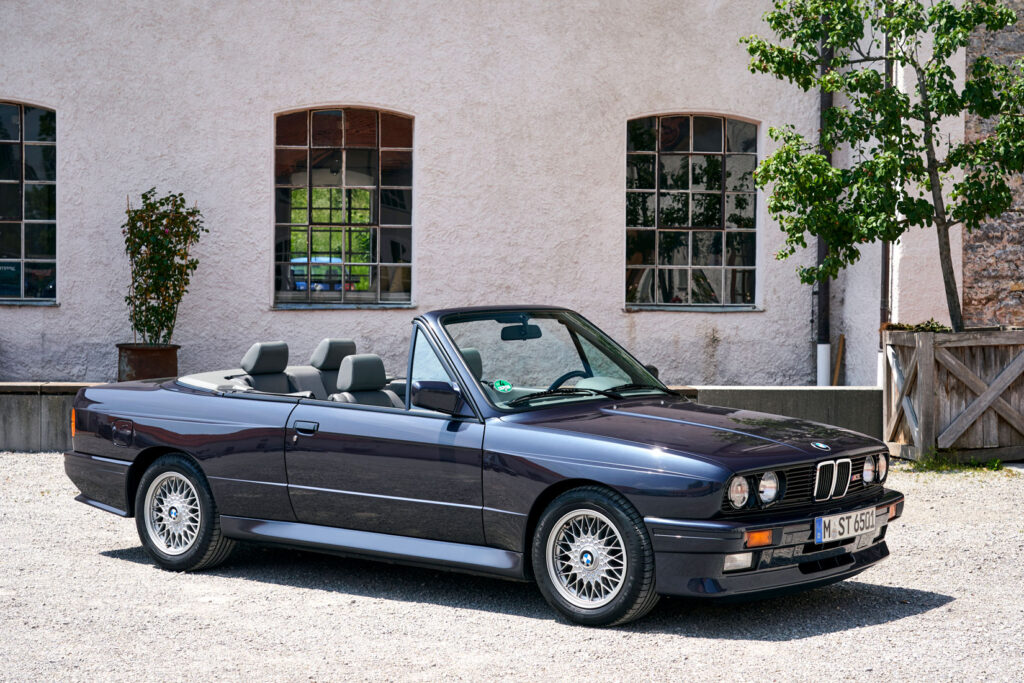
The era of the BMW 3 Series (E30) – 1982 to 1994
«With the E30 series, the 3 Series was available for the first time as a four-door sedan or as a Touring.»
Special requests and foresight
Although the market volume was small in a global context, Switzerland was considered important in Munich. The first BMW model with all-wheel drive, the 325 iX (1985), was developed not least due to numerous requests from Switzerland. BMW achieved a market share of around 4% in Switzerland.
As early as 1992, BMW (Switzerland) AG demonstrated foresight regarding sustainability. In collaboration with a car dismantler, a process was developed to reduce the proportion of non-recyclable waste materials by up to 44%.
Major investments
In 1990, BMW (Switzerland) AG sold more than 14,000 vehicles annually in Switzerland. Around 150 employees contributed to this success.
In 1990, BMW (Switzerland) AG first entered the financial services sector with its "BMW Leasing" division. In 1994, this business unit was taken over by the newly founded BMW Financial Services (Switzerland) AG, an independent subsidiary. Since then, the two companies have operated externally as BMW Group Switzerland.
Read more
Up until 1994, BMW (Switzerland) AG underwent a major investment phase to prepare for the future. Around 200 million Swiss francs were invested in new facilities and renovations in accordance with corporate identity guidelines. The headquarters in Dielsdorf was also renovated and remodeled. A showroom and a used car center were opened there in January 1995.
1999 was the BMW Group Switzerland's best financial year to date. Sales rose to 900 million Swiss francs, an increase of 8.6% compared to the previous year. A total of 12,031 passenger cars and 1,517 motorcycles were delivered. The 3 Series was the best-selling model with approximately 7,200 units sold.

The era of the BMW 3 Series (E36) including the 3 Series Compact – 1990 to 2000:
"As with its predecessor, in addition to the classic sedan, a two-door coupé, a convertible and a Touring were also available."

The era of the BMW 3 Series (E46) including the 3 Series Compact – 1998 to 2007:
"With the E46, BMW once again offered the 3 Series with all-wheel drive. The E46 celebrated its world premiere at the 1998 Geneva Motor Show."
MINI delights Switzerland
The BMW Group Switzerland started the new millennium with a turnover exceeding one billion euros for the first time in 2000; 183 people were employed in Dielsdorf at that time. With the introduction of the first BMW X5, BMW reinforced its all-wheel-drive expertise from 2000 onwards and offered a Sports Activity Vehicle (SAV) for the first time.
MINI was added to the product range in 2001. The new brand was aimed primarily at women and younger buyers. This plan proved successful: In the 2002 financial year, the brand achieved a market share of 1.27%, and within its segment, it reached 6.5% – a top European figure.
Read more
The Mini launch was complex. Two-thirds of BMW dealerships had to be supplied with new MINI cars without impacting their existing business. Furthermore, the dealerships had to create a completely independent brand presence for MINI.
2002 marked another milestone in the history of BMW Group Switzerland: The Swiss Army ordered 400 F-Series motorcycles for 4.8 million Swiss francs. To this day, the Swiss Army continues to rely on BMW motorcycles.
At the end of the 2002 financial year, sales amounted to CHF 1.3 billion. 13,455 BMW vehicles were sold, along with 3,715 MINIs and 1,980 BMW motorcycles (excluding military vehicles). At that time, 236 employees worked for the BMW Group Switzerland. In addition, there were 95 dealerships, 65 of which sold MINIs and 31 sold BMW motorcycles.
In 2002, the parts and accessories warehouse in Dielsdorf was closed and replaced by a large showroom. And on December 16, 2003, the groundbreaking ceremony for the new BMW Group Switzerland headquarters took place at Industriestrasse 20 in Dielsdorf.
In 2004, BMW Group Switzerland recorded another record year, selling 17,158 passenger cars. BMW achieved a 68.4% increase within 10 years – even though the Swiss market experienced a slight decline during this period.
The employees moved into the new office building in the spring of 2005. The building was officially inaugurated on May 20, 2005.
Due to the crisis
BMW quickly left the competition behind in Switzerland. With 20,372 cars sold, BMW became number one in the premium segment in 2007. "In Switzerland, we were particularly helped by our wide range of models and our xDrive all-wheel-drive system," the then Managing Director summarized the success in an interview. "Furthermore, the new MINI has achieved a similar cult status to its original."
With the arrival of the first BMW X6 in 2008, another successful model made its debut in Switzerland. BMW Sauber F1's Formula 1 involvement from 2006 to 2009 likely also contributed to BMW's positive image in Switzerland. While the engines were manufactured in Munich, the Sauber team employed around 400 people in Hinwil (ZH).
Read more
The global economic crisis also caused the Swiss car market to shrink. However, the BMW Group passenger car division (BMW and MINI) was able to consolidate its market share at 6.8% and continuously increase vehicle sales: 17,541 units in 2009, 19,722 units in 2010, and 22,113 units in 2021.
BMW Motorrad also saw positive sales figures: 2,028 units were registered in 2009, representing a market share of 11.7% (over 500 cc). This figure rose to 2,364 units (14.3%) in 2010 and 2,991 units (15.5%) in 2011.

The era of the BMW 3 Series (E90) – 2005 to 2013
: "With the X3 (from 2003 onwards), the 3 Series now has competition from within its own ranks. However, the fifth generation, also available as a Touring and with xDrive, continues to enjoy high demand in Switzerland."

The era of the BMW 3 Series (F30) – 2011 to 2019:
"The F30 was also available as a sedan and Touring, while the Coupé and Convertible were sold as the 4 Series with this model generation. Hybrid powertrains were also available for the first time."
New paths
In November 2013, the BMW i3, the first all-electric model from BMW i, was launched in Switzerland at a starting price of 39,950 Swiss francs. The completely redesigned model celebrated its Swiss premiere at the Zurich Motor Show. In its debut year, the i3 was voted the greenest car of the year by readers of the Swiss magazine "Schweizer Illustrierte," making for a perfect start.
Furthermore, BMW Group Switzerland recorded a new record year with 25,029 automobiles and 3,235 motorcycles sold.
Read more
In March 2016, the BMW Group Brand Experience Center was opened at the headquarters in Dielsdorf. With a selection of around 100 demonstration vehicles, the center continues to offer first-class support for dealerships and the best conditions for experiencing the models from BMW, MINI and BMW Motorrad.
In October 2016, the BMW i3 was once again in the spotlight: As part of the "SBB Green Class" pilot project, a collaboration between Swiss Federal Railways (SBB) and BMW Group Switzerland, test customers received a subscription model that included a general season ticket, a BMW i3 with a home wallbox, and access to a car and bike sharing service. A perfect example of an innovative and networked mobility solution.
In 2017, BMW Group Switzerland surpassed the 30,000 mark for car sales in Switzerland and Liechtenstein for the first time. BMW Motorrad also topped the sales statistics for motorcycles with engines larger than 500 cc, with 4,774 units sold.
Friend and helper
The group continued its successful run in Switzerland, achieving a market share of 10% in 2018. For police forces, the 3 Series, 5 Series, and X models have been popular vehicles for years and decades. In 2019, BMW Group Switzerland delivered its first all-electric patrol vehicle to the Wädenswil (ZH) municipal police.
In 2020, the BMW branch in Zurich-Dielsdorf, which opened in 1995 (the only sales and service partner owned by the BMW Group Switzerland), was sold and has since been operated by the Hedin Group.
Read more
Despite the uncertain market situation caused by the coronavirus pandemic, BMW Group Switzerland achieved a market share of 11.1% in 2020, thus continuing to grow relative to the market environment. Furthermore, as in every year since 2016, the company met the federal government's CO2 emissions targets in 2020.
The iX, another member of the BMW i family, was launched in 2021. In September 2022, BMW Group Switzerland delivered the world's first iX as a police vehicle, continuing a long tradition.
With 25,251 registrations, BMW Group Switzerland almost reached pre-pandemic sales levels in 2023. Ideal conditions for Sergio Solero, who took over as President & CEO of BMW (Switzerland) AG on March 1, 2024.

The present: the BMW 3 Series (G20) – since 2018
«With the seventh generation of the 3 Series presented in 2018, BMW placed even more emphasis on a versatile drive portfolio – and thus once again captured the spirit of the times.»


BMW Art Cars
For five decades now, BMW has shaped the automotive landscape of Switzerland with a distinctive blend of technical precision, timeless design language and a consistent spirit of innovation.
50 years,
20 Art Cars,
2 legends,
1. Topic
1975 was not only the founding year of BMW Group Switzerland, but also of BMW Art Cars. Art auctioneer and racing driver Hervé Poulain had succeeded in convincing BMW racing director Jochen Neerpasch and the BMW board to commission artist Alexander Calder to design a BMW 3.0 CLS for use at Le Mans. This initial work was followed by a total of 19 more BMW Art Cars. At the anniversary party in Zurich, Sven Grützmacher, Director of Corporate Communications, together with Jochen Neerpasch, Liechtenstein motorsport legend Max Heidegger, and Classic Driver CEO JP Rathgen, looked back on the golden era of motorsport.